Photography On Location

Let the light breath

June 10th, 2010

There is a saying I like use when teaching lighting classes, ‘let the light breath.’  This refers to figuring out what is the best lighting ratio between outside ambient light and your strobe on the subject.  There is  no right answer.  When shooting assignments the client often tells you what style of lighting and mood they are looking for, other times they give you full creative control.  Ratios can go from a fill flash ration where the flash is almost the same exposure as the daylight, or to very dramatic with the ambient light being underexposed 2 stops or more.

I like to darken my ambient exposure from minus 1/2 to 2 stops on many shots, especially if there are clouds.  Darkening my ambient allows my flash ‘to breath’.  With a dark background I can really see my lighting and the fine details of accent lights and subtle fill.  With a fill flash ratio of lighting the strobe is less apparent or not even obvious….and that might be your goal for the shot.  There is no right answer.

Yesterday I was working with Greg, a local athlete in town, a runner, jumper, fighter…a very talented guy.  We worked on some running shots on the university track, and I liked the mood and intensity of this image.  And the background was underexposed 1 1/2 stops to achieve this effect.

Tech: Nikon D3, 45mm tilt shift, 1/200 at f27. ISO 100.  One Elinchrom Ranger was used with a Freelite A head shot through a 39″  Rotalux deep Octabox .  Triggered by the Skyport wireless system.

D3s Glidetrack video

June 1st, 2010

The Poudre river near my house is running at peak flows right now, which means time to kayak, and photograph kayaking. Nothing beats being on the river on a sunny day surfing a good wave.  My friend Patrick is always on the river, so we thought he would be a perfect subject for a short multimedia piece.  See the video.

We have been using the Glidetrack for some moving video shots. This clever mini dolly system produces great moving shots using the D3s.  The first few clips in this video are using this system. Below is a shot of the set up in the water.

To solve the problem of contrast on Patrick boating we used one Elinchrom Ranger shot through a Freelite A head with standard reflector.  The A head has a faster flash duration and better for stopping fast moving action.  We get many questions about how the Elinchrom Rangers perform.  Put simply, they always perform…in rain, wind, sand, tornados (seriously!) and even getting soaked by a large river wave (not recommended).

Tech: Nikon D3,  24-70mm, 1/250 at F11, ISO 100.  Elinchrom Ranger shot through Freelite A head, standard reflector.  Skyport System used to trigger flash.

D3s video

May 17th, 2010

I have been working on some video projects for an upcoming article and really enjoyed exploring the capabilities of DSLR video. I worked with Chris the other day in an urban part of town. We have done a lot of shoots together and practically know what the other person is thinking when it comes to poses and concepts. The difference this time was shooting video along with stills on the same shoot.  Take a look at the HD video.  

I used my 45mm tilt shift lens for a number of the soft focus clips. And I used the Redrock Micro Captain Stubling for hand held video and follow focus with my lens.  Using the Stubling really opened up camera angles for us.  I found shooting video very easy on the D3s, and was amazed at the quality.  720p HD video at 24fps has a great cinematic quality to it and worked perfect for this shoot. For lighting on the video we used Litepanel Micro Pro lights.

For lighting on the stills we used Elinchrom Quadras.  I am using these lights more and more… light, convenient and powerful.   I really like being able to use the same accessories as with our larger Rangers.

We have been using some new post processing technique in CS5  I learned from Matt Kloskowski.  Matt is a great guy and gladly shares his wealth of knowledge about CS5 and Lightroom.  If you haven’t checked out the videos at Kelby Training (www.kelbytraining.com) on his techniques and much more, you should take a look. We also had a chance to do a couple training videos for Kelby Training, stay tuned for these episodes soon!

Tech: Nikon D3s for video (variety of lenses), D3 for stills; 24-70mm lens, 1/250 at F11, ISO 200.  Elinchrom Quadra packs with A heads for lighting, one light shot through a gridded (rotagrid) 27″ square Rotalux softbox, the other shot with a standard reflector attached. Skyports triggered the lights wirelessly from the camera.  Video: Capt. Stubling rig from Redrock Micro used for handheld shots, Litepanel Micro Pro lights used for video.

blending white balance

May 11th, 2010

I have been in Moab a lot lately, two assignments and one workshop, always enjoy getting back to the desert.  One night I went out to a boulder with some petroglyphs, and tried some lightpainting with my D3s.  Since the noise performance of this camera is hard to believe, I experimented with both long and short exposures for differrent effects with the stars.  I really liked how the stars rendered sharp with exposures around 20 seconds, which required an ISO of 3200…hardly any noise, amazing!

I like my white balance set around 3000 Kelvin for the deep blue skies it produces, but wasn’t that happy with how flat the rock and petroglyphs came out.

With my white balance set to around 6000 Kelvin, the rock looked good.  To solve this white balance issue, I saved two copies of the original raw file, one with a white balance for the sky, and the other for a good white balance for the rock.  Then I combined the two in CS4, and brushed back in the warm rock in the cool blue sky shot. The top image is the result.  Tech: D3s, 14-24mm, 20 seconds at F4, ISO 3200.

Miami and Greek Food

May 4th, 2010

I have been on the road a lot lately, Moab, Canyonlands, Arches, and now just in from Miami.  My friend, Cesar Rivera, and the Pines West Camera Club invited me down to speak and teach a class on TTL flash photography. I have to say they rolled out the red carpet for me, a great group of people and a very active club. We worked on some flash images at the hotel I was staying at, and we had 5 incredible models to work with (thanks Elvisay!).  I had a chance to shoot a few frames of Claudia, a fantastic model, sure makes my job easier when you have beautiful people to photograph.  Just used one Elinchrom Quadra shot through a 39″ octabox for this image.

One item that was a real hit was the Lastolite Ezybox.  We used the 24″ size, love the quality of TTL flash coming through these. We also used the grid panels to control and modify the light.  My favorite is the narrow strip, really narrows the light down, great for tight places where you don’t want spill.

And the greek food?  The club took me out to Taverna Opa restaurant for some great food, but what really caught my attention were belly dancers and patrons dancing on the table as I ate, quite the dining experience!

Tech (portrait): Nikon D3s, 24-70mm, 1/250 at F18, ISO 100. Elinchrom Quadra shot through a 39″ Octabox, triggered by Skyport wireless system.

Attaching the SB900 to a Justin Clamp

April 20th, 2010

If you use SB900s, like I do, then you may wonder how to attach them to some accessories since the flash’s larger hot shoe plate won’t fit a standard TTL cold shoe mount. One item we use frequently are Manfrotto Justin Clamps, they are very handy to attach SB900s in a variety of situations. The SB900 will not attach to the cold shoe mount that comes with the Justin Clamp, but there is an easy fix.  I unscrew the plastic cold shoe mount and replace it with a Stroboframe flash mount adapter.

To attach the Stroboframe bracket, use a 1/4″ x 3/4″ set screw socket.  These screws can be found at any hardware store.  Just screw the socket into the clamp, and then screw the Stroboframe bracket onto this.  You’re ready to go!

vintage cars

April 12th, 2010

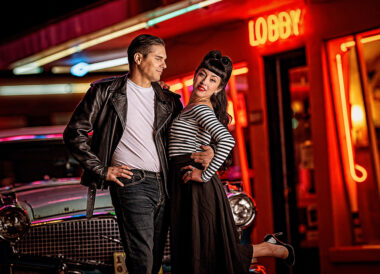
Had a fantastic shoot come together the other day.  I have a neighbor who has a classic Lincoln Continental and he offered it as a prop for a photograph.  Of course this brought to mind lots of different ideas, something like a vintage 50s drive-in.  Then I met Rachael, a model in town, whose green eyes and red hair just seemed to fit this concept perfectly.  We set up at a local park, and thanks to lots of grip help, things went great.

When I shoot on a sunny day I like to put my subject in the shade, or create my own.  I want only my lights to be illuminating the model, not harsh sun.  To accomplish this we put up a big 78″ x 78″‘ Lastolite Skylite with diffusion material to soften the sun on Rachael.  The main light on the top image was an Elinchrom Ranger shot through a deep Rotalux Octabox. Next we placed another head gridded to 40 degrees and shot through the back window to add highlights to her hair. To add some highlight on her right side we used another Ranger head gridded to 30 degrees coming through the windshield to hit her right side.

Tech: Nikon D3s, 24-70mm lens, 1/250 at F10, ISO 200. Elinchrom Rangers used with A Heads, one deep 39 ” Rotalux Octabox as main light, gridded heads for accent lights.

Baja

April 7th, 2010

Just back from spending a week in one of my favorite places anywhere, Baja California MX.  I guided sea kayaking trips here for years, and when Photo Quest Adventures asked about running a workshop there, I couldn’t wait.  The Sea of Cortez is loaded with marine life, and our trip confirmed it.  We saw numerous whales including Humpback, Blue, Pilot, Finback and dolphins by the hundreds.  The Humpback whales were breaching, and the game began to see who could get a shot of a breaching whale.  I caught this one in the distance.  This was the first trip I got to try out my D3s, and shooting at really high ISOs was perfect for fast shutter speeds to stop the action.

A highlight of the trip for me was when two of our group renewed their wedding vows.  I wanted to do a portrait of them, and had the idea of having them neck deep in the ocean.  I really like this look, especially with a sunset in the background, just something about putting people in the water that really brings things to a pure, clean level.  John and Suzy were happy to oblige, and waded out in their nice clothes.  The lighting for this was one Lastolite Ezybox and a SB900.  In order to reduce the amount of flash power needed, and reduce recycle times, I took out the internal baffle in the Ezybox.  Tech (portrait) Nikon D3s, 24-70mm, 1/125 at F5.6, ISO 200. SB900 triggered with a SU800 transmitter, shot through a 24″ Lastolite Ezybox.

Red Waterfall

March 27th, 2010

I was recently in Arches National Park, and they have had a lot of snow and rain this spring.  Rain can produce some interesting things to photograph in the desert including rainbows and reflection pools on the slickrock.  But what I hadn’t seen before was a bright red waterfall.  This little stream in the park only runs after a shower, but this time it was running really strong and bright orange due to the sediment in the water.  I’ve seen some murky creeks after storms before, but this stream really had strong color.  Despite the rain I set up with a rain cover on my camera, and used the Singh-Ray Vari-ND filter to get a slow shutter speed.  This filter blocks from 2-8 stops of light, and is a great way to reduce light and produce slow shutter speeds in the middle of the day.  Speeds up 30 seconds are possible even with sun.  Tech: Nikon D3, 24-70mm, 13 seconds at F11, ISO 200.

San Diego

March 23rd, 2010

Just returned from a workshop in San Diego for the Mentor Series. Myself and Essdras Suarez, a shooter for the Boston Globe, were the instructors for the group.  We had a great group and packed in the shooting and teaching.  The students enjoyed seeing our two different styles of shooting everything from landscapes to portraits.  I really enjoyed the surf shoot, and had a quick moment to photograph Josh during this  session.  I used my new favorite lens, the Nikon 45mm tilt shift, for the shot in available light.


digital photography
© Copyright Tom Bol Photography | Usage Policy | Site Developers